Readings:
[Common of a Prophetic Witness]
[For Peace]
[For Social Justice]
[For Prophetic Witness in Society]
Preface of a Saint (1)
PRAYER (traditional language)
Strengthen and protect, O God, all those who suffer for their fidelity to Jesus Christ; that, like thy servant Toyohiko Kagawa, they might persevere in seeking and serving Christ in all persons, and work tirelessly for the advancement of thy kingdom, through the same Jesus Christ our Lord, to whom with thee and the Holy Ghost be all honor and glory now and forever. Amen.
PRAYER (contemporary language)
Strengthen and protect, O God, all those who suffer for their fidelity to Jesus Christ; that, like your servant Toyohiko Kagawa, they might persevere in seeking and serving Christ in all persons, and work tirelessly for the advancement of your kingdom, through the same Jesus Christ our Lord, to whom with you and the Holy Spirit be all honor and glory now and forever. Amen.
Lessons revised in Lesser Feasts & Fasts 2024.
Return to Lectionary Home Page
Webmaster: Charles Wohlers
Last updated: 22 Feb. 2025
TOYOHIKO KAGAWA
RENEWER OF SOCIETY, 23 APRIL 1960
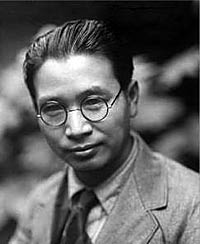 Toyohiko
Kagawa was born in 1888 in Kobe, Japan. Orphaned early, he lived first
with his widowed stepmother and then with an uncle. He enrolled in a Bible
class in order to learn English, and in his teens he became a Christian
and was disowned by his family. In his late teens, he attended Presbyterian
College in Tokyo for three years. He decided that he had a vocation to
help the poor, and that in order to do so effectively he must live as
one of them. Accordingly, from 1910 to 1924 he lived for all but two years
in a shed six feet square (about 180 cm) in the slums of Kobe. In 1912
he unionized the shipyard workers. He spent two years (1914-1916) at Princeton
studying techniques for the relief of poverty. In 1918 and 1921 he organized
unions among factory workers and among farmers. He worked for universal
male suffrage (granted in 1925) and for laws more favorable to trade unions.
Toyohiko
Kagawa was born in 1888 in Kobe, Japan. Orphaned early, he lived first
with his widowed stepmother and then with an uncle. He enrolled in a Bible
class in order to learn English, and in his teens he became a Christian
and was disowned by his family. In his late teens, he attended Presbyterian
College in Tokyo for three years. He decided that he had a vocation to
help the poor, and that in order to do so effectively he must live as
one of them. Accordingly, from 1910 to 1924 he lived for all but two years
in a shed six feet square (about 180 cm) in the slums of Kobe. In 1912
he unionized the shipyard workers. He spent two years (1914-1916) at Princeton
studying techniques for the relief of poverty. In 1918 and 1921 he organized
unions among factory workers and among farmers. He worked for universal
male suffrage (granted in 1925) and for laws more favorable to trade unions.
In 1923 he was asked to supervise social work in Tokyo. His writings began to attract favorable notice from the Japanese government and abroad. He established credit unions, schools, hospitals, and churches, and wrote and spoke extensively on the application of Christian principles to the ordering of society.
He founded the Anti-War League, and in 1940 was arrested after publicly apologizing to China for the Japanese invasion of that country. In the summer of 1941 he visited the United States in an attempt to avert war between Japan and the US. After the war, despite failing health, he devoted himself to the reconciliation of democratic ideals and procedures with traditional Japanese culture. He died in Tokyo 23 April 1960.
— by James Kiefer