Readings:
1 Kings 19:1-9
Psalm 121
Colossians 4:2-6
John 16:12-22Preface of God the Son
[Common of a Theologian and Teacher]
[Common of a Monastic or Professed Religious]
[Of the Holy Spirit]
[Of the Incarnation]
PRAYER (traditional language)
Judge eternal, throned in splendor, who didst give John of the Cross strength
of purpose and faith that sustained him even through the dark
night of the soul: Shed thy light on all who love thee, in unity with
Jesus Christ our Savior; who with thee and the Holy Spirit livest and
reignest, one God, for ever and ever. Amen.
PRAYER (contemporary language)
Judge eternal, throned in splendor, who gave John of the Cross strength
of purpose and faith that sustained him even through the dark
night of the soul: Shed your light on all who love you, in unity with
Jesus Christ our Savior; who with you and the Holy Spirit lives and reigns,
one God, for ever and ever. Amen.
Lessons revised at General Convention 2024.
Return to Lectionary Home Page
Webmaster: Charles Wohlers
Last updated: 12 October 2024
JOHN OF THE CROSS
MYSTIC AND MONASTIC REFORMER, 1591
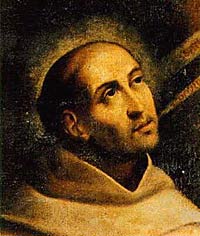
Juan de Ypres y Alvarez was born in 1542. His father died soon after, and Juan was brought up in an orphanage. (His father was probably Jewish. It is remarkable how many of the most memorable Spanish Christians have been of Jewish background.) At seventeen, he enrolled as a student in a Jesuit college, and at twenty-one, he joined the Carmelite Friars. He was ordained in 1567, and almost immediately met Teresa of Avila, a Carmelite Nun who was undertaking to return the Order to its original strict rule, which had been gradually relaxed to the detriment, as she believed, of the spiritual lives of the members of the Order. Those who followed the strict rule as promulgated by Teresa went barefoot or wore sandals instead of shoes, and so became known as Discalced (unshod) Carmelites, or Carmelites of the Strict Observance. John undertook to adopt the stricter rule and encourage others to do so.
Not all members of the order welcomed the change. In 1577 a group of Calced Carmelites, or Carmelites of the Ancient Observance, kidnapped John and demanded that he renounce the reform. When he refused, he was imprisoned in complete darkness and solitude in a Calced monastery in Toledo for about nine months. He then escaped and fled to a Calced monastery. While imprisoned at Toledo, he had begun to compose some poems, and now he wrote them down, with commentaries on their spiritual significance.
He was given various positions of leadership among the reformed friars, but then dissension broke out among the reformers between "moderates" and "extremists." John supported the moderate party, and when the extremists gained control, they denounced him as a traitor to the reform. He was sent to a remote friary, and fell ill, and finally died at Ubeda during the night preceding 14 December 1591.
His poems include:
The Dark Night of The Soul (about the experience of spiritual desolation, of feeling abandoned and rejected by God, and why this is for some Christians a means by which God increases our faith in Him; about the Christian walk, the life of prayer and contemplation, and growing in love and grace)
The Ascent of Mount Carmel (same poem as the preceding, but with a different commentary attached)
The Spiritual Canticle (about the love between the Christian and Christ as symbolized by the love between bride and groom; draws heavily upon the imagery of the Song of Solomon)
The Living Flame of Love (about the soul transformed by grace)
His works have been translated into English by David Lewis (1906), and by E. Allison Peers (1953). His poems have been translated by Roy Campbell and are available in Penguin paperback. The following extracts are quoted from the poetic translation by Peers.
From The Spiritual Canticle:
Whither hast vanished
Beloved, and hast left me full of woe,
And like the hart hast sped,
Wounding, ere thou didst go,
Thy love, who follow'd, crying high and low? ...Oh that my griefs would end!
Come, grant me thy fruition full and free!
And henceforth do thou send
No messenger to me,
or none but thou my comforter can be. ...My love is as the hills,
The lonely valleys clad with forest-trees,
The rushing, sounding rills,
Strange isles in distant seas,
Lover-like whisperings, murmurs of the breeze.My love is hush-of-night,
Is dawn's first breathings in the heav'n above,
Still music veiled from sight,
Calm that can echoes move,
The feast that brings new strength--the feast of love ...Rare gifts he scattered
As through these woods and groves he pass'd apace
Turning, as on he sped,
And clothing every place
With loveliest reflection of his face. ...The creatures, all around,
Speak of thy graces as I pass them by.
Each deals a deeper wound
And something in their cry
Leaves me so raptur'd that I fain would die.
from The Living Flame of Love:
O Living flame of love
That, burning, dost assail
My inmost soul with tenderness untold,
Since thou dost freely move,
Deign to consume the veil
Which sunders this sweet converse that we hold ...And O, ye lamps of fire,
In whose resplendent light
The deepest caverns where the senses meet,
Erst steeped in darkness dire,
Blaze with new glories bright
And to the loved one give both light and heat!
by James Kiefer
Several of his sworks are online at CCEL.