Readings:
Leviticus 10:1-3
Psalm 103:13-18
Philippians 4:10-13
Luke 14:1-14Preface of a Saint (2)
[Common of a Pastor]
[Of the Incarnation]
[For the Ministry]
PRAYER (traditional language)
Heavenly Father, whose son our Lord Jesus Christ didst take the form of a servant for the sake of his brothers and sisters: Strengthen us with the prayers and example of thy servant Chad, who became the least of all to minister to all; through the same Christ our Lord, who liveth and reigneth with three and the Holy Ghost, one God, now and for ever. Amen.
PRAYER (contemporary language)
Heavenly Father, whose son our Lord Jesus Christ took the form of a servant for the sake of his brothers and sisters: Strengthen us with the prayers and example of your servant Chad, who became the least of all to minister to all; through the same Christ our Lord, who lives and reigns, with you and the Holy Spirit, one God, now and for ever. Amen.
Lessons revised at General Convention 2024.
Return to Lectionary Home Page
Webmaster: Charles Wohlers
Last updated: 4 January 2025
CHAD OF LICHFIELD
(2 MAR 672)
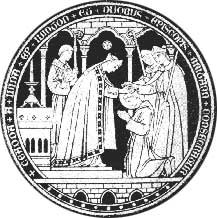 Chad,
Bishop of Lichfield, is perhaps best known for NOT being Archbishop of
York. He was elected and duly installed, but various persons raised objections,
and rather than cause division in the Church he withdrew in favor of the
other candidate, Wilfrid (see 12 Oct). (The objection was that some of
the bishops who had consecrated him--although not Chad himself--were holdouts
who, even after the Synod of Whitby had supposedly settled the question
in 663, insisted on preserving Celtic customs on the date of celebrating
Easter and similar questions, instead of conforming to the customs of
the remainder of Western Christendom.) He was soon after made Bishop of
Lichfield in Mercia. There he travelled about as he had when Archbishop
of York, always on foot (until the Archbishop of Canterbury gave him a
horse and ordered him to ride it, at least on long journeys), preaching
and teaching wherever he went. He served there for only two and a half
years before his death, but he made a deep impression. In the following
decades, many chapels, and many wells, were constructed in Mercia and
named for him. (It was an old custom to dig a well where one was needed,
and to mark it with one's own name or another's, that thirsty travellers
and others might drink and remember the name with gratitude.)
Chad,
Bishop of Lichfield, is perhaps best known for NOT being Archbishop of
York. He was elected and duly installed, but various persons raised objections,
and rather than cause division in the Church he withdrew in favor of the
other candidate, Wilfrid (see 12 Oct). (The objection was that some of
the bishops who had consecrated him--although not Chad himself--were holdouts
who, even after the Synod of Whitby had supposedly settled the question
in 663, insisted on preserving Celtic customs on the date of celebrating
Easter and similar questions, instead of conforming to the customs of
the remainder of Western Christendom.) He was soon after made Bishop of
Lichfield in Mercia. There he travelled about as he had when Archbishop
of York, always on foot (until the Archbishop of Canterbury gave him a
horse and ordered him to ride it, at least on long journeys), preaching
and teaching wherever he went. He served there for only two and a half
years before his death, but he made a deep impression. In the following
decades, many chapels, and many wells, were constructed in Mercia and
named for him. (It was an old custom to dig a well where one was needed,
and to mark it with one's own name or another's, that thirsty travellers
and others might drink and remember the name with gratitude.)
by James Kiefer