Readings:
Genesis 11:1-9
Psalm 13
Acts 1:1-9
Mark 6:7-13Preface of Apostles and Ordinations
[Common of a Missionary]
[Common of a Pastor]
[For the Ministry]
[For the Mission of the Church]
PRAYER (traditional language):
Keep thy church from discouragement in the day of small things, O God, in the knowledge that when thou hast begun a good work, thou shalt bring it to a fruitful conclusion, just as thou didst for thy servant Anskar; through Jesus Christ our Lord, who liveth and reigneth with thee and the Holy Ghost, one God, for ever and ever. Amen.
PRAYER (contemporary language):
Keep your church from discouragement in the day of small things, O God, in the knowledge that when you have begun a good work, you will bring it to a fruitful conclusion, just as you did for your servant Anskar; through Jesus Christ our Lord, who lives and reigns with you and the Holy Spirit, one God, for ever and ever. Amen.
Lessons revised at General Convention 2024.
Return to Lectionary Home Page
Webmaster: Charles Wohlers
Last updated: 7 Dec. 2024
ANSKAR,
BISHOP AND MISSIONARY TO DENMARK AND SWEDEN (3 FEB 865)
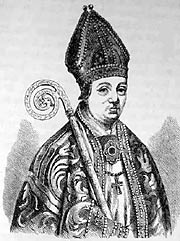 Anskar
(in Latin, Ansgarius) was a monk of Saxon family, born in Corbie,
France, in 801 (the year after the crowning of Charlemagne). In 826, when
King Harald of Denmark asked Charlemagne's successors for missionaries,
Anskar led a group to Denmark, and a few years later to Sweden.
Because of unsettled political conditions, his work ran into difficulties,
and Anskar withdrew into Germany, where he served as first Archbishop
of Hamburg. Later, however, he helped to consecrate Gotbert, the first
bishop of Sweden. The Church of Sweden honors him as its apostle, and
he serves as symbol of the historic friendship and present-day connection
between the Anglican Churches and the Church of Sweden.
Anskar
(in Latin, Ansgarius) was a monk of Saxon family, born in Corbie,
France, in 801 (the year after the crowning of Charlemagne). In 826, when
King Harald of Denmark asked Charlemagne's successors for missionaries,
Anskar led a group to Denmark, and a few years later to Sweden.
Because of unsettled political conditions, his work ran into difficulties,
and Anskar withdrew into Germany, where he served as first Archbishop
of Hamburg. Later, however, he helped to consecrate Gotbert, the first
bishop of Sweden. The Church of Sweden honors him as its apostle, and
he serves as symbol of the historic friendship and present-day connection
between the Anglican Churches and the Church of Sweden.
by James Kiefer
In the north of Germany, in Denmark, and in Sweden, Anskar, who had been a monk at Corbey,
on the Weser, laboured for thirty-nine years with earnest devotion and with great success
(AD 826-865). In addition to preaching the Gospel of salvation, he did much in such
charitable works as the building of hospitals and the redemption of captives; and he
persuaded the chief men of the country north of the Elbe to give up their trade in
slaves, which had been a source of great profit to them, but which Anskar taught them to
regard as contrary to the Christian religion. Anskar was made archbishop of Hamburg and
Bremen, and is styled "The Apostle of the North." But he had to suffer many
dangers and reverses in his endeavours to do good. At one time, when Hamburg was burnt by
the Northmen, he lost his church, his monastery, his library, and other property; but he
only said, with the patriarch Job, "The Lord gave, and the Lord hath taken away;
blessed be the name of the Lord!" Then he set to work again, without being
discouraged by what had befallen him, and he even made a friend of the heathen king who
had led the attack on Hamburg. Anskar died in the year 865. It is told that when some of
his friends were talking of miracles which he was supposed to have done, he said, "If
I were worthy in my Lord's sight, I would ask of Him to grant me one miracle--that He
would make me a good man."
from Sketches of Church History, by J. C. Robertson, publ. 1904 by SPCK, London
Also available, "Saint Anschar", from The Catholic Encyclopedia, and The Life of Anskar, by his successor, Rimbert (also available from the Internet Archive).